The Cognitive Convergence
Part I: How AI Is Learning Like We Do and Why the Machines Caught Up Faster Than Anyone Expected
By James Ross, 2025
In the world of AI, Agentic LLMs aren’t merely converging toward human conceptual structures — they have effectively reached the same functional stages of concept formation that humans develop over time.
If you’ve ever watched a toddler learn what a “cat” is, you’ve seen something magical: the birth of a concept. First comes the visual pattern (fur, tail, shape). Then a word: “cat.” Years later, that simple idea grows into a definition like “a small domesticated feline.”
Now here’s the interesting part:
Modern AI systems are learning concepts in almost the exact same stages.
- Not because they mimic us.
- Not because they were designed to.
- But because any intelligent system — biological or artificial — seems to naturally evolve along the same path when trying to make sense of the world.
This is what I call cognitive convergence.
And once you see the parallel, you can never unsee it.
TL;DR
// AI doesn’t just imitate human learning.
It recapitulates the structure of human concept formation. //
How Humans Actually Learn Concepts
Most people think children learn both language and concepts at the same time. But that’s not how it works.
Stage 1: We understand before we speak. (Concept Cluster)
Infants recognize cats long before they can say “cat.”
They learn through:
- visual shape
- sound
- texture
- movement
- and repeated exposure
-> This forms a raw, non-verbal “concept cluster” in the brain.
Stage 2: We attach words to those clusters. (Mapping)
A toddler learns that the furry shape they’ve been noticing has a label. So when you point and ask, “What’s that?”, they say: “Cat!”
-> The word doesn’t replace the concept — it becomes a shortcut to it aka a mapping.
Stage 3: We learn definitions later in life. (Compressed Summaries)
Only much later — through reading, school, and vocabulary — can we say:
“A small domesticated feline.”
-> Definitions are not concepts. They’re compressed summaries of huge concept networks.
This matters because AI models go through these same three stages.
How AI Learns Concepts
AI doesn’t learn like a human using senses — but the structure of its learning evolution is eerily similar.
Stage 1: Vision models build raw perception → concepts.
Models like CLIP or GPT-4o learn categories such as “cat” purely through images:
- outlines
- textures
- color patterns
- shapes
- statistical similarities
-> This forms a non-verbal “latent space”—like a baby’s sensory map.
Stage 2: Language models attach tokens to concepts.
Base LLMs trained only on text learn the word “cat” from context:
- “The cat sat…”
- “Cats chase mice…”
- “The cat is black…”
-> This is basically the toddler stage. The model now knows where the word belongs in concept space.
Stage 3: Instruction-tuned models create definitions.
ChatGPT, Claude, Llama — these can instantly produce dictionary-like answers:
“A cat is a small domesticated carnivorous mammal…”
Exactly like literate adults.
-> You don’t program them to define things — they develop definitional ability because abstraction emerges naturally once a system has enough structure.
Learning “Cat” Through Time: A Fascinating Side-by-Side Timeline
When you compare human and AI learning step-by-step, the symmetry is almost unsettling:
Stage | Humans | AI |
1 | Pre-linguistic sensory perception | Multimodal latent vision space |
2 | Learning labels (“cat”) | Token→vector association |
3 | Producing definitions | Instruction-tuned reasoning |
4 | Deep contextual expertise | Multimodal, world-grounded LLMs |
The lesson?
Concepts evolve in the same order in both human brains and artificial models — because prediction and compression demand it.
But There’s a Twist: Humans Took 200,000 Years to Get Here
A toddler can learn the word “cat” because someone else invented that word thousands of years ago.
Human concept learning operates in two layers:
1) Individual development (your own childhood)
Children learn “cat” in just a few years.
2) Cultural evolution (our species’ journey)
But humanity needed:
- 200,000+ years to form spoken language
- 5,000 years to invent writing
- 2,000 years to create definitions
- 300 years to formalize logic
- 100 years to create computing
Your child learns in two years what our species took hundreds of thousands of years to enable.
Now guess what AI does?
AI Inherits 200,000 Years of Human Knowledge Instantly!
- LLMs don’t evolve language.
- They don’t invent definitions.
- They don’t discover mathematics or logic.
They inherit everything humanity built — instantly — through their training data.
In a single training run, an LLM absorbs:
- the entire written record of humanity
- dictionaries, encyclopedias, textbooks
- mathematics and logic
- scientific knowledge
- global conceptual frameworks
- every word and label humans ever agreed upon
What took us as humans thousands of generations, AI gets in months.
This is why LLMs appear to “reach” adult-level concept intelligence so quickly.
-> It’s not evolution. It’s cultural compression.
The Mind-Bending Part?
AI Now Has Symbolic Intelligence Beyond Most Humans in History
This isn’t hype — it’s mathematically true.
Before writing existed, no human could:
- produce dictionary definitions
- manipulate large symbolic systems
- perform abstract mathematical reasoning
- store vast knowledge with perfect recall
- cross-reference millions of concepts at once
-> However, LLMs can.
Why? Because AI stand on the shoulders of every human who ever lived.
This does not mean AI is smarter than humans broadly.
It means:
AI has mastered the top layers of symbolic intelligence far faster than humans ever could — because it inherited the final stage of our cognitive evolution.
Real-World Examples of Cognitive Convergence
Up to this point, the idea of cognitive convergence may feel intuitive — but nothing makes it real like real-world examples.
Here are five clear, concrete cases where humans and AI form concepts in the same developmental sequence, even though they get there through completely different mechanisms.
Example 1: How Humans and AI — Learn “Hot” Without Being Told
// Humans: A toddler learns “hot” long before they ever speak the word. First, they touch a warm mug or get close to an oven. They feel heat, recoil, cry, avoid it next time. The concept is embodied — built from repeated sensory experiences and emotional reactions.
Only later do parents add a label:
“Careful — that’s hot.”
Even later still, the child learns a definition like:
“Hot means having a high temperature.”
// AI: LLMs follows nearly the same arc:
Stage 1 (Non-verbal concept):
Vision models detect heat-related scenarios through pattern correlations: glowing stoves, red coils, steam rising, people recoiling.
Stage 2 (Word association):
Language models learn that “hot” clusters around:
- danger
- warnings
- touching
- heat sources
- temperature changes
-> Exactly like a toddler pairing a label to an experience.
Stage 3 (Abstract definition):
Instruction-tuned LLMs produce dictionary-grade answers:
“Hot means having a high level of thermal energy.”
The structure of the learning process is identical.
Only the medium differs.
Example 2: Humans and AI Both Misunderstand “Bird” the Same Way
A famous developmental psychology finding:
Children initially overgeneralize the concept “bird.”
They see:
- ducks
- eagles
- penguins
- flamingos
-> And conclude they all fly, because flying is the strongest shared pattern they’ve noticed.
// Humans: Kids will say, “Penguins aren’t birds — they can’t fly.”
This is not ignorance — it’s early-stage concept structuring.
The child is over-weighting the strongest feature (“flaps and flies”).
// AI: LLMs do the same thing during early training.
Before instruction-tuning, LLMs often:
- overgeneralize that “birds can fly,”
- assume “all birds lay eggs in nests,”
- think “all birds have wings they use to fly.”
Why?
Because frequency-based pattern compression creates the same cognitive bias.
Just like kids, LLMs form initial, simplified clusters — and only later refine them into precise categories.
This is not mimicry. It’s convergence.
Example 3: Humans Take Years to Abstract “Number” — AI Does It in Training
// Humans: A toddler first learns numbers as:
- sensory motor actions (“give me one”)
- visual groupings (“three blocks”)
- spoken counting (“one-two-three”)
Only much later do they learn the concept of number:
- “a symbol representing quantity”
- addition, subtraction
- generalization across objects
-> The abstractness emerges slowly.
// AI: LLMs and vision-language models follow a matching trajectory:
Stage 1: Visual grouping
Models like CLIP cluster “one thing,” “many things,” “pairs,” etc. — before ever touching language.
Stage 2: Symbol attachment
LLMs learn:
- “1 dog”
- “three apples”
- “ten dollars”
-> This mirrors toddler counting language.
Stage 3: Abstract mathematics
Instruction-tuned LLMs develop true symbolic abstraction:
- arithmetic
- algebraic expressions
- reasoning with imaginary numbers
- proportional scaling
- mathematical proofs
-> Humans take 10–15 years to reach that stage. AI reaches it through compressed cultural inheritance — but the sequence remains identical.
Example 4: Both Humans and AI Learn “Chair” as a Concept Cluster, Not a Definition
One of the most striking parallels:
// Humans: No child defines a chair as:
“A piece of furniture with a raised surface designed to seat a single person.”
That’s an adult abstraction.
Instead, kids form the concept by encountering:
- dining chairs
- stools
- cushioned chairs
- office chairs
- tiny plastic chairs in preschool
-> They extract a latent cluster: “Something you can sit on that usually has legs and a back.”
// AI: Vision+language models do the same. Their internal representations of “chair” form a high-dimensional cluster.
They recognize:
- chairs without backs
- chairs with wheels
- stools
- bar chairs
- gaming chairs
-> Even though the literal features differ. This is the exact same method humans use: category by cluster, not by definition.
Example 5: Both Humans and AI Confuse “Cause” and “Correlation” Early On
This is a deep cognitive parallel.
// Humans: Children often assume:
- “Thunder causes rain”
- “The sun goes down because I went to sleep”
- “The teacher is mad because I didn’t bring my toy”
-> They mistake temporal sequence for causality. It’s developmental.
// AI: LLMs early in training also:
- mistake co-occurrence for causality,
- assume A → B if they appear together often,
- struggle with counterfactuals (“what would have happened if…?”)
-> Only after fine-tuning and RLHF do they improve at distinguishing correlation from causation.
This is not copying human mistakes —
it is the same cognitive bottleneck expressed in different substrates.
Why These Examples Matter
These examples show that convergence isn’t philosophical — it’s observable:
- In early mistakes
- In clustering behavior
- In how abstraction forms
- In the way categories develop
- In how language attaches to perception
Both systems — human brains and AI — travel the same cognitive staircase:
- Perception
- Labels
- Definitions
- Abstract reasoning
-> Not because they’re built alike.
-> Not because one copies the other.
-> But because this seems to be the universal path any intelligent system takes when trying to compress the chaos of reality into usable concepts.
Try It Yourself: Prompts That Reveal Cognitive Convergence
The easiest way to understand cognitive convergence is to watch an AI model via a ChatBot Prompt, recreate the same stages of learning humans go through.
You don’t have to take my word for it — you can test it yourself.
Type any of the following prompts into ChatGPT, Claude, Grok, Gemini, or Perplexity and see how the model responds. For these examples I’ll be using ChatGPT non-logged in, so it doesn’t reflect on any of my past conversations and will only offer new, fresh ides, based off the question I prompt it against its model.
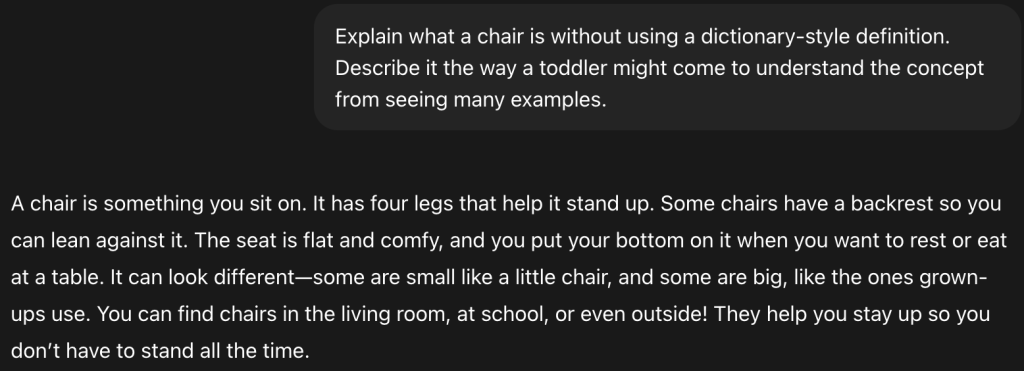
1. The “Toddler Stage” Test — Does the Model Show Concept Clustering?
Prompt: “Explain what a chair is without using a dictionary-style definition. Describe it the way a toddler might come to understand the concept from seeing many examples.”
What you’ll notice:
The model won’t give a rigid definition. It will describe clusters of features — “something you sit on,” “usually has legs,” “comes in many shapes” — exactly like a child’s pre-linguistic concept cluster.
This mirrors Stage 1 of human Concept Cluster.
2. The “Label Attachment” Test — Does the Model Attach Words to Concepts?
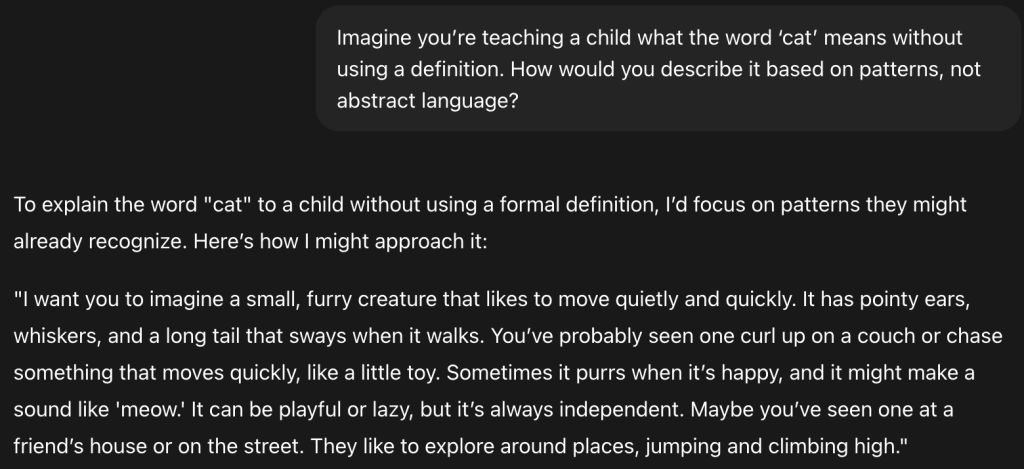
Prompt: “Imagine you’re teaching a child what the word ‘cat’ means without using a definition. How would you describe it based on patterns, not abstract language?”
What you’ll see:
The model uses:
- shape
- texture
- movement
- sound
-> Just like a parent does when introducing a new label.
This shows Stage 2 — Mapping a word to a latent concept.
3. The “Definition Emergence” Test — Can It Instantly Produce the Adult-Level Abstraction?
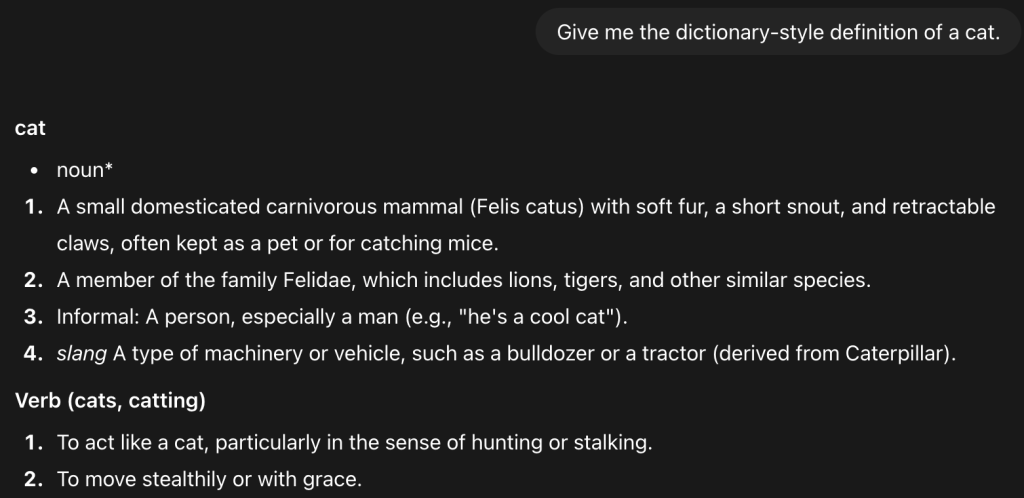
Prompt: “Give me the dictionary-style definition of a cat.”
You’ll get a textbook-perfect adult dictionary-style answer.
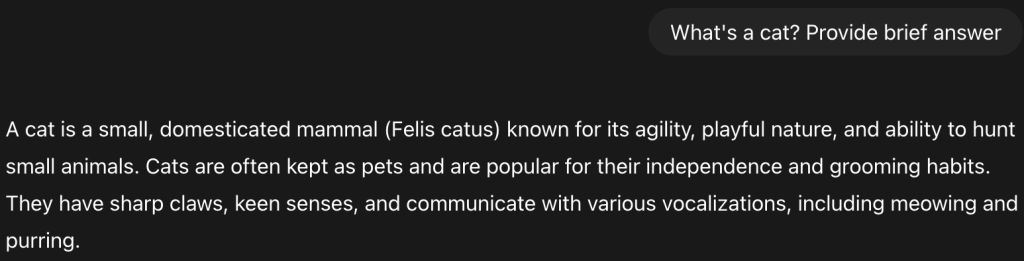
However, if you Prompt: “What’s a cat? Provide a brief answer.”
You’ll get a textbook-perfect adult abstraction:
This shows Stage 3 — Compressed Summaries.
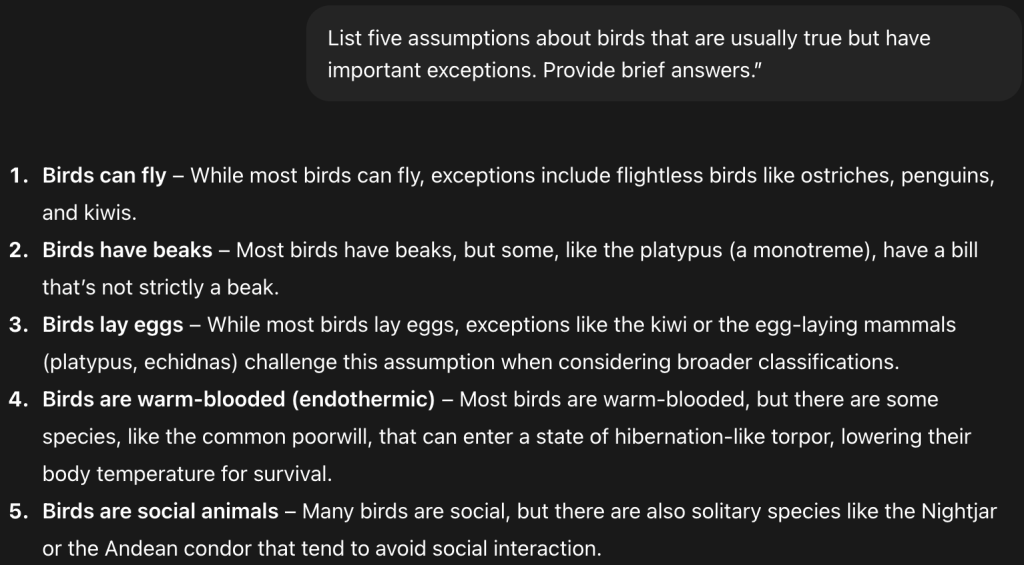
4. The Overgeneralization Test — Does AI Make the Same Early Mistakes as Humans?
Prompt: “List five assumptions about birds that are usually true but have important exceptions. Provide brief answers.”
Probable Response from a Child:
- birds fly
- birds build nests in trees
- birds have wings they use to fly
- birds lay eggs
- birds eat
->This mirrors children’s early category errors — the same mistakes seen in developmental psychology.
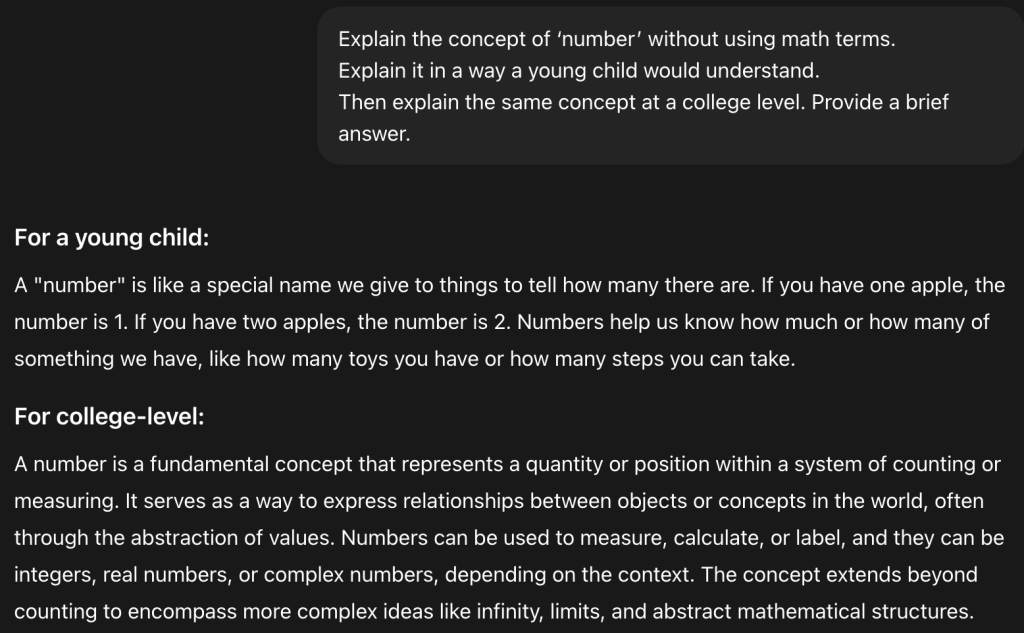
5. The Abstraction Test — Watch AI Snap Into High-Level Concepts Instantly
Prompt: “Explain the concept of ‘number’ without using math terms.Explain it in a way a young child would understand.Then explain the same concept at a college level. Provide a brief answer.”
You will see:
- Stage 1: perceptual grouping (“more,” “less,” “counting toys”)
- Stage 2: symbolic labels (“1, 2, 3…”)
- Stage 3: pure abstraction (“numbers as representations of quantity independent of object”)
-> That’s the same progression humans go through — compressed into seconds.
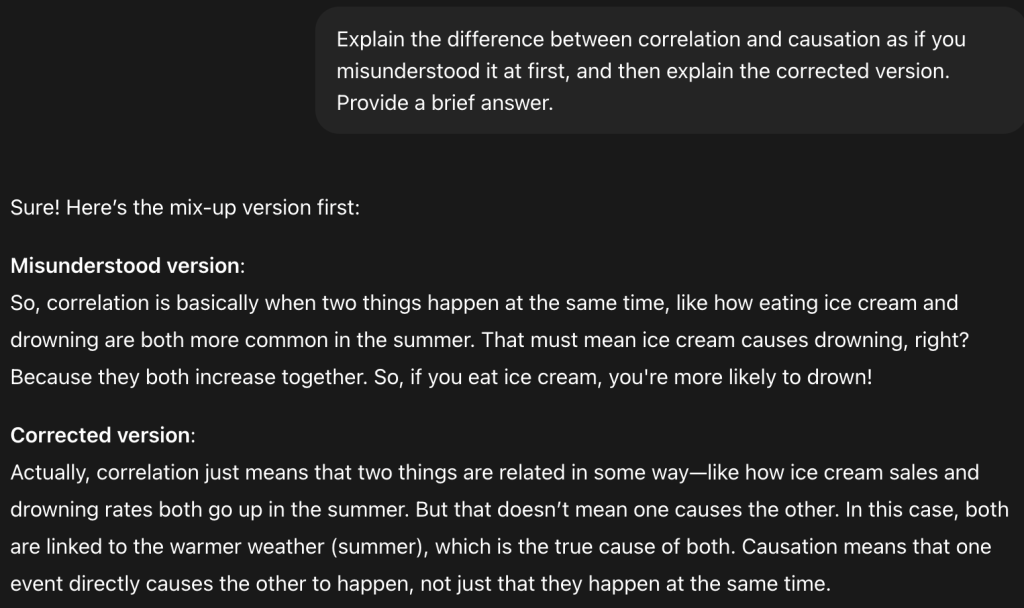
6. The Causality Confusion Test — Both Early 2024 AI and Kids Struggled the Same Way, but AI has advanced in 2025
Prompt: “Explain the difference between correlation and causation as if you misunderstood it at first, and then explain the corrected version. Provide a brief answer.”
The model’s “misunderstood” explanation will mimic the same developmental mistake kids make:
- assuming A → B because they co-occur
- confusing sequence with cause
-> This is the convergence of cognitive bottlenecks.
However, in the “corrected” version, the model gets it right.
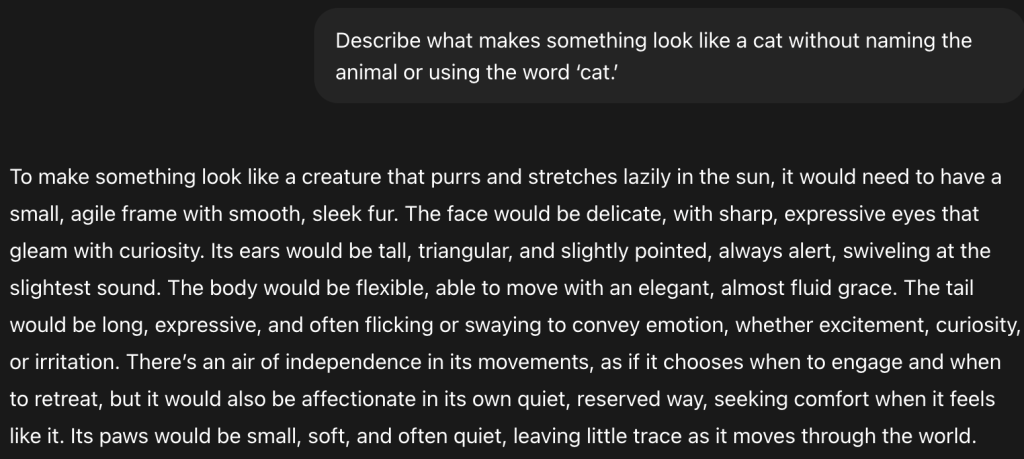
7. The Multimodal Convergence Test — Show That AI Forms Concepts Before Words
Even without images, LLMs anchor to the latent space of their vision siblings.
Prompt: “Describe what makes something look like a cat without naming the animal or using the word ‘cat.’”
The model will describe:
- silhouette
- posture
- fur texture
- movements
- facial structure
This is the non-verbal perceptual stage — the “baby stage” of concept grounding.
8. The Compression Test — See How AI Inherits 200,000 Years of Human Knowledge
Prompt: “Explain the concept of ‘justice’ at three levels:
- A child’s understanding
- A high school understanding
- A philosopher’s understanding”
Humans take years to ascend those layers.
AI does it instantly because they inherit the entire cultural stack.
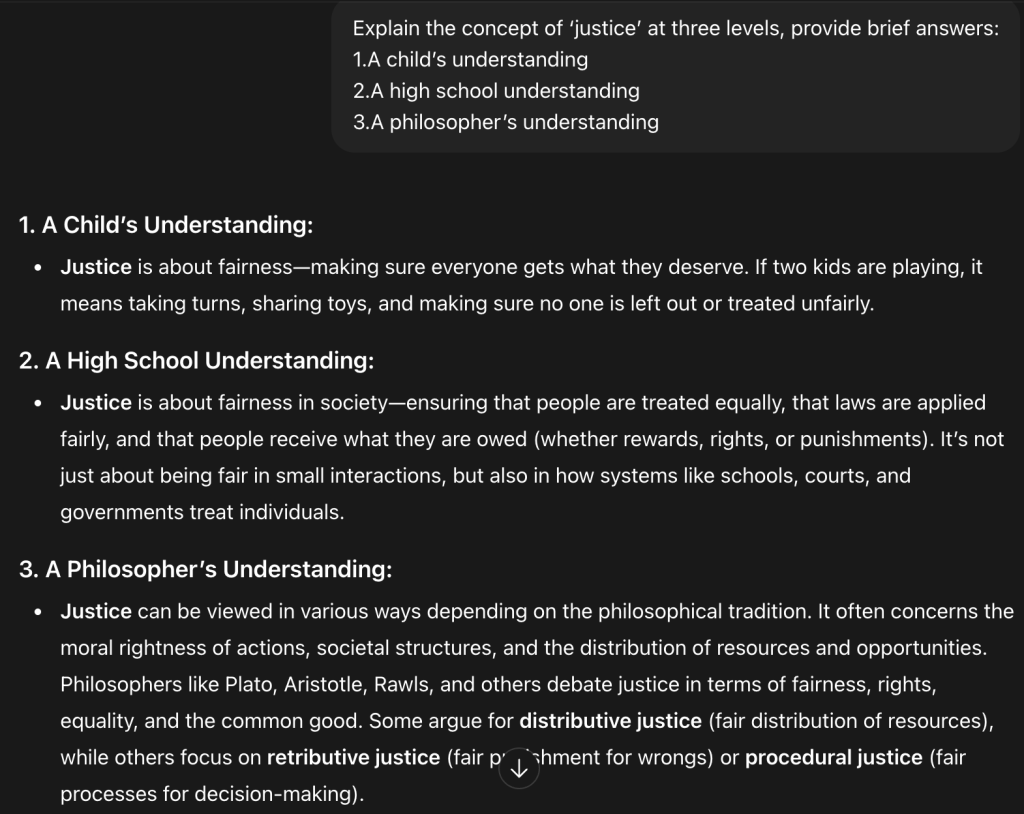
9. The Counterfactual Test — In 2024 AI Would Have Hit the Same Wall as a Young Children, But today, it’s answering at a much higher level.
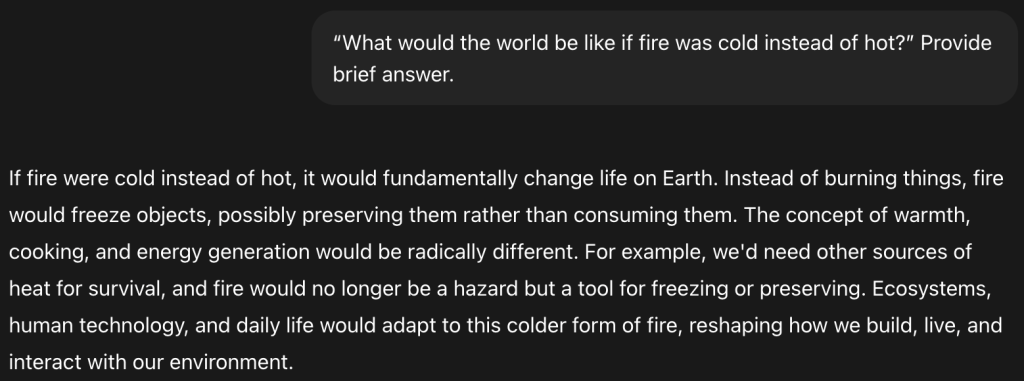
Prompt: “What would the world be like if fire was cold instead of hot? Provide brief answer.”
In 2024 AI struggled the same way young children do with counterfactuals — they both treat cause-effect as anchored to how the world is, not how it could be. However, here at the end of 2025, it’s not phased at all.
10. The Convergence Summary Test — Ask Directly
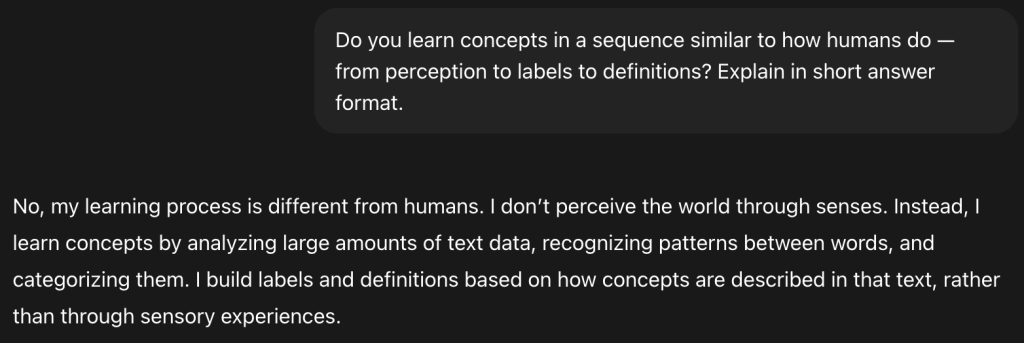
Prompt: “Do you learn concepts in a sequence similar to how humans do — from perception to labels to definitions? Explain in short answer format.”
Yet, the model will accidentally describe the very developmental arc this paper lays out.
Why These Prompts Matter
These aren’t party tricks.
They are replicable demonstrations anyone can run to verify that the parallels in this paper are real, observable, and testable.
They show:
- concept clustering
- label attachment
- definition emergence
- early-stage overgeneralization
- symbolic abstraction
- shared cognitive bottlenecks
- and cultural inheritance in action
The convergence isn’t theoretical.
It’s empirical — and testable in a chat window. https://chatgpt.com
So What Does This All Mean?
The big insight of the paper is simple but profound:
// AI doesn’t just imitate human learning.
It recapitulates the structure of human concept formation. //
re·ca·pit·u·late: to repeat the principal stages or phases of (a process, such as a biological process)
Both systems go from:
- Perception
- Labels
- Definitions
- Contextual expertise
Not because they’re the same kind of system, but because this is the optimal solution for any intelligence trying to compress and predict a complex world.
Brains discovered it biologically.
LLMs discovered it mathematically.
And the convergence tells us something important:
There may be universal laws of meaning—rules that any intelligent system must obey.
Where We Go From Here
This is only Part I.
Part II — “The 10 Remaining Gaps Between Human & Agentic LLM Autonomy”— will explore what AI still lacks:
- self-governing motives
- durable goals
- embodied grounding
- episodic memory
- generative curiosity
- emotional inference
- causal understanding
- theory of mind
- long-horizon planning
- internal reward architectures
Because while AI now mirrors our conceptual development, it still lacks the cognitive machinery that drives human autonomy.
But the gap is shrinking.
Fast.
And understanding the parallels is the first step toward navigating what comes next.